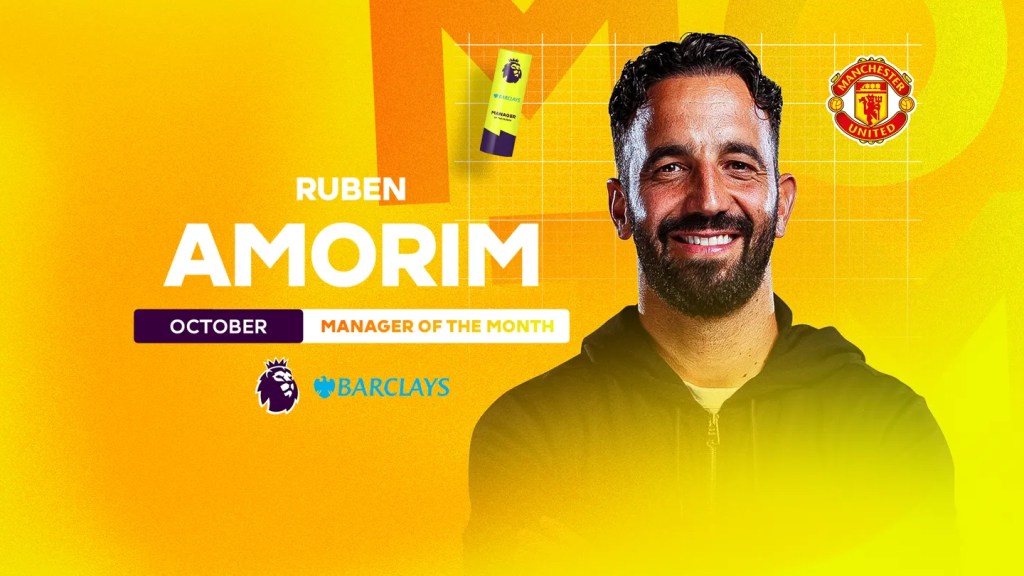
Manchester United head coach Rúben Amorim has been named the Premier League’s Barclays Manager of the Month for October 2025 after three wins from three — the club’s first perfect league month under his tenure. On the same day, Bryan Mbeumo took the EA SPORTS Player of the Month, giving United their first awards double since November 2023.
Because monthly awards validate multi-match form rather than a single result, the immediate fallout is a recalibration of narratives and early pricing across previews; analysts at GGBet typically fold these momentum signals — along with fresh injury notes — into opening markets within the first 24–72 hours.
Why does this matter beyond one weekend
Awards don’t hand out points, but they validate multi-match trends rather than single-game spikes. Amorim topped a four-man shortlist — Mikel Arteta, Unai Emery, and Andoni Iraola — through the usual fan/expert combined vote. This recognition lands in a volatile month for Premier League dugouts: Wolves dismissed Vítor Pereira on 2 November after a winless start, underscoring the premium on stability.
What changed on the pitch
Amorim’s post-award message credited the squad and framed the goal as “win the next one,” a nod to process over narratives. The October tape shows repeatable patterns rather than luck.
Stable selection and clearer roles
United strung together matches with minimal rotation, making pressing triggers and build-up routes look cleaner week to week. That continuity has been rare since his 2024 appointment and aligns with the club’s own emphasis on short-term consolidation before tweaking details.
Transitions over sterile possession
The most dangerous phases arrived just after turnovers, with wide combinations feeding late box entries instead of early hopeful crosses. Mbeumo’s ball-carrying and final pass numbers matched the eye test, culminating in a two-goal finish to the month against Brighton.
Where this sits in the wider Premier League picture
The contrast with Wolves is instructive. Pereira’s sacking — less than two months after a contract extension — illustrates how quickly technical-area narratives can flip when results and underlying numbers diverge. Clubs consolidating around a clear idea tend to compound small gains; clubs firefighting often take a performance hit before any rebound under a new coach. That divergence frames the stakes as the schedule tightens into late November and early December.
Context across the league
This uptick at Old Trafford contrasts sharply with turbulence elsewhere. Wolves’ decision to part ways with Pereira — days before this award cycle concluded — illustrates how early-season skids compress decision timelines. Managerial churn tends to depress short-term results; United’s October, by contrast, is a case of compounding gains from selection stability.
Fixtures and relevance window
The narrative will stay live for several weeks: November and early-December fixtures test whether October’s patterns sustain against top-half opposition. Even if form cools, the awards themselves are fixed outcomes dated 7 November 2025, preserving news value for outreach through late November.
Selection stability became a competitive edge
Across October, Amorim resisted wholesale rotation and trusted a consistent spine. That decision aligned with the month’s output: three league wins, goal difference +5, and United’s first Anfield victory in nearly a decade (2–1 on 19 October). That match also marked the first time under Amorim that United delivered back-to-back league wins, before finishing the month with a 4–2 win against Brighton. The Premier League’s own award notes confirm the sequence (Sunderland 2–0, Liverpool 2–1, Brighton 4–2) and the improvement trend.
The award context is objective, not sentimental
Barclays Manager of the Month is determined by a split between a fan vote and an expert panel. The October shortlist — Rúben Amorim (Man Utd), Mikel Arteta (Arsenal), Unai Emery (Aston Villa), Andoni Iraola (Bournemouth) — was published before the final decision; the league then confirmed Amorim as the winner on 7 November 2025, his first such award at United and the club’s first since November 2023. Parallel confirmation came the same day for Bryan Mbeumo as EA SPORTS Player of the Month, creating a club double that mirrors the underlying results.
What the numbers imply without over-claiming
The Premier League’s award dossier lays out the verified outputs; beyond that, the safest inference is structural:
- A settled XI correlates with cleaner spacing and fewer low-percentage shots.
- Transitions rather than sterile possession produced the best chances.
- Wide combinations created the final-third advantage that Mbeumo exploited. Those are process signals that tend to survive opponent scouting for a few weeks, which is why you’ll see them echoed in tactical previews and early pricing notes (where outlets often reference momentum, injury clarity, and role continuity alongside headline scores).
A useful comparator: dugout volatility elsewhere
In the same news cycle, Wolves dismissed Vítor Pereira after a winless start (two points from 10), underlining how early-season turbulence can distort performance trends. That contrast — United compounding small gains versus a rival resetting the project — explains why monthly awards often track with medium-term outcomes. If stability holds, it tends to show up first in repeatable patterns (press timings, rest-defence positions) before it shows in league-table leaps.
 PremierLeagueNow
Leave a comment